
The Legal Gap: Why Commercial Success is a Personal Trap
Recently the DEA changed Cannabis in the Controlled Substances Act, from Schedule I to Schedule III status—traditionally reserved for substances like anabolic steroids—which only provides legal protection when the drug is handled by federal registrants and dispensed via a valid prescription.
This presents a massive conflict: state-authorized home growing simply doesn’t fit that “pharmacy” model. Without a specific exemption, the DEA can technically argue that while cannabis is now “less dangerous,” home cultivation remains the “manufacturing” of an unapproved drug.
The strategy Carl Olsen is pursuing leverages the DEA’s own authority to create a specific rule so that the Act’s provisions do not apply to patients authorized by their state to grow their own medicine.
The 2026 Crisis: A Monopoly on Medicine & “Two-Tier System”
The April 2026 rescheduling order was a surgical strike designed for the industry. It moved state-licensed commercial products to Schedule III, allowing corporate dispensaries to begin expedited registration. However, it left individual patients in a legal lurch. We now have a “Two-Tier System” where a dispensary sells a Schedule III substance, but a patient growing the exact same plant just ten miles away is technically in possession of a Schedule I substance.
By ignoring the “everything else” category, the DEA has created a legal trap. This “split” status isn’t just confusing; it’s a violation of civil rights.
The DEA will claim they are protecting the “drug pipeline,” but in reality, they are creating a federal monopoly on medicine that ignores the hundreds of thousands of patients in the 24 states that allow home cultivation.
Our Strategy: The May 1st Petition
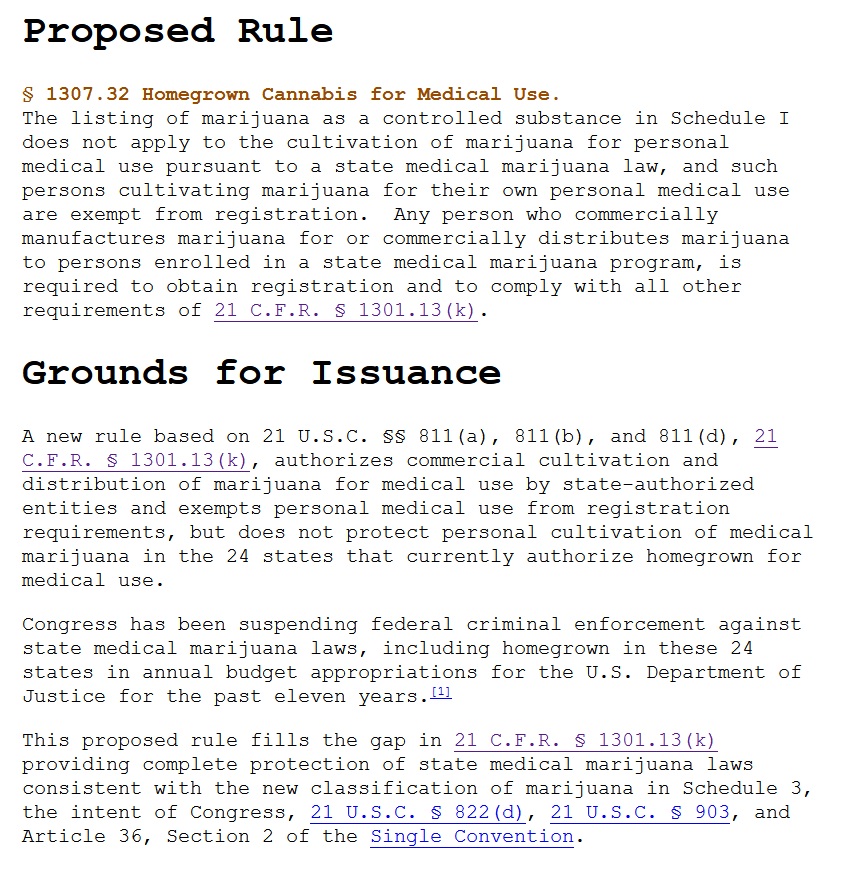 During the past week Carl Olsen and myself have been thinking how do we deal with this? To address this administrative failure, on May 1, 2026, Carl is filing a formal Petition for Rulemaking. By proposing the creation of § 1307.32 before the June hearings even begin, we are forcing the DEA to acknowledge that their current “Schedule III for business, Schedule I for people” divide is untenable.
His petition rests on two powerful pillars:
-
The Peyote Precedent: Just as the DEA used 21 C.F.R. § 1307.31 to carve out an exemption for the religious use of a Schedule I substance, they have the clear authority under 21 U.S.C. § 822(d) to do the same for state-authorized medical use.
-
Administrative Consistency: It is “arbitrary and capricious” for a federal agency to treat a plant as Schedule III when a corporation sells it, but Schedule I when a patient grows it.
Congress never intended to create a corporate monopoly when they passed the budget riders protecting state laws. This petition, filed May 1st, 2026, ensures that the DEA’s administrative rules finally align with the intent of Congress and the fundamental rights of the people.
Here is a copy of the Petition and as soon as we have any updates to the status I will be letting you know.